The feature reached every Google user this week. The one thing Google has not explained is which sites its standing agent returns to, and that is where local businesses get seen or get skipped.

On Monday, September 28, Robby Stein, Google’s vice president of product for Search, announced that AI Mode’s information monitoring is rolling out to every user, globally. Until that morning, the feature had belonged to paying subscribers. Now any Google account can tell AI Mode to keep watching a topic, and Google will keep checking for changes, continuously, in the background.
Stein’s examples were all local and all commercial: new restaurants or pop-ups opening nearby, holiday activities for kids, back-in-stock alerts, price drops. In the demo video attached to his post, a user asks AI Mode to flag weekend pop-ups, and the system replies that it has “set up a task to keep you updated” on vintage markets in Austin, listing flea markets, stoop sales, and block parties among the things it will watch (Search Engine Journal, Sept. 29; Search Engine Roundtable, Sept. 28).
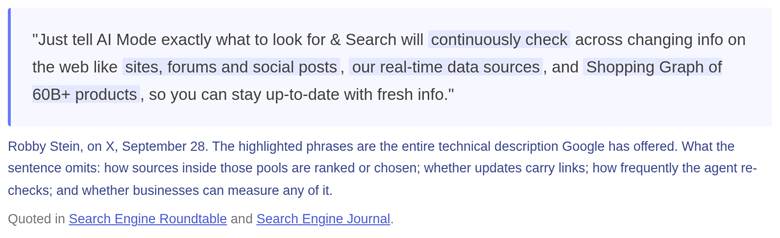
What Google has not said, in this announcement or any before it, is how the agent decides which sites, forums, feeds, and products make it into an update. Search Engine Journal’s Matt G. Southern put the gap plainly: “Local businesses and retailers can’t yet tell from either post how often monitoring updates will surface their sites or send them visits.”
What a monitoring task is
Stein described the mechanism in a single post: “Just tell AI Mode exactly what to look for & Search will continuously check across changing info on the web like sites, forums and social posts, our real-time data sources, and Shopping Graph of 60B+ products, so you can stay up-to-date with fresh info. And it’ll even suggest tasks when you’re searching.”
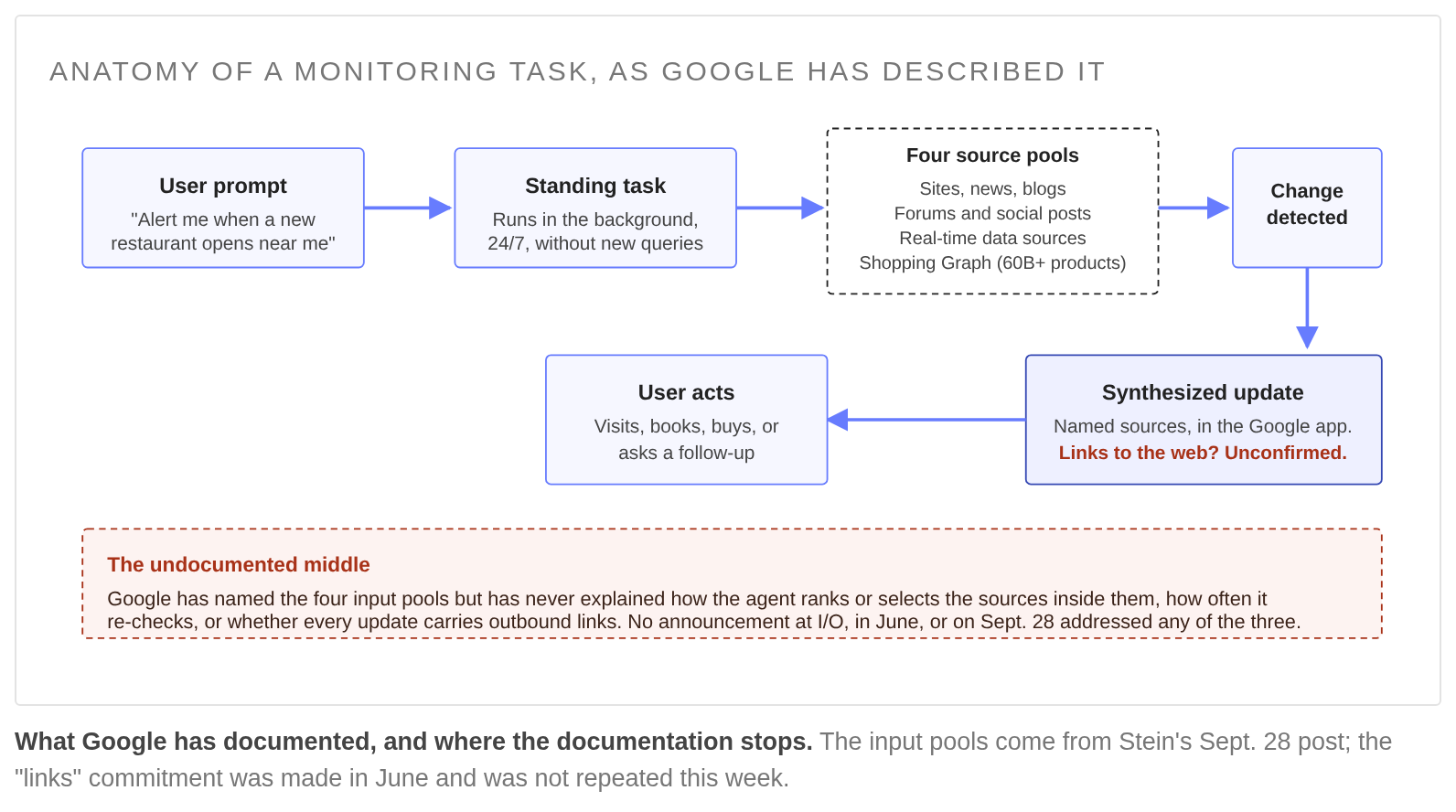
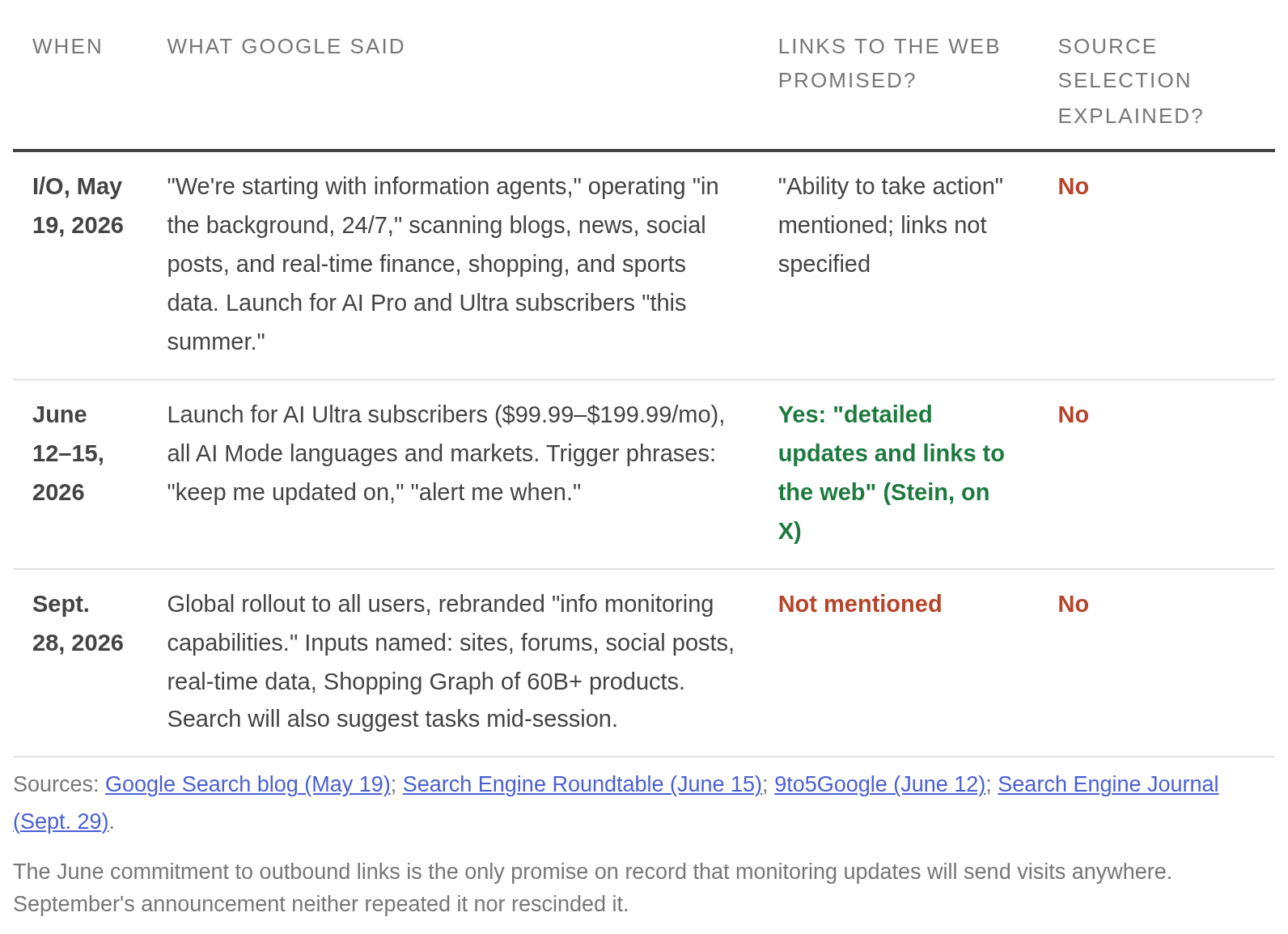
At I/O in May, Google described information agents as software that operates “in the background, 24/7” and “intelligently reason[s] across information to find exactly what you need at exactly the right moment” (Google Search blog, May 19, 2026). When the feature launched in June, it cost money: Google AI Ultra subscriptions run $99.99 to $199.99 per month, and Stein promised the agents would “send detailed updates and links to the web the moment new info is available” (Search Engine Roundtable, June 15; 9to5Google, June 12). This week the same capability became free, global, and available in the Google app for everyone. Google also says AI Mode itself has passed one billion monthly users, with queries doubling every quarter since launch, so the audience for these tasks is not a beta cohort.
Why this changes the economics for a business
Search engine optimization has always been an auction over a query. Someone types “new restaurants Springfield,” and ten businesses get shown, and the auction repeats every time someone asks. Monitoring removes the repetition. A user who sets one task (“keep me updated on new restaurants near me”) stops running that query. There is no results page anymore for that person’s demand, just a standing instruction and whatever the agent eventually surfaces.
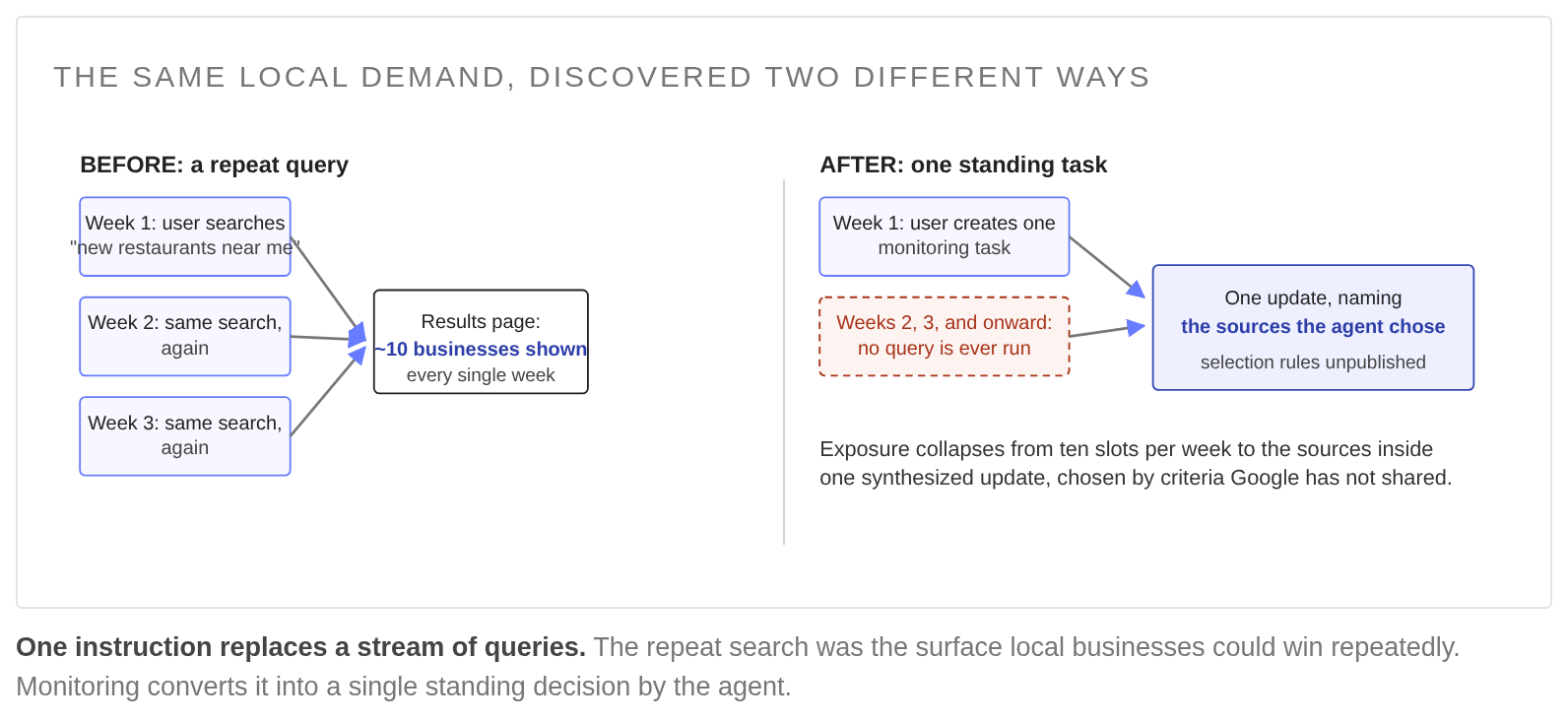
This is the fourth compression of search exposure in as many years, and the first one that removes the query itself:
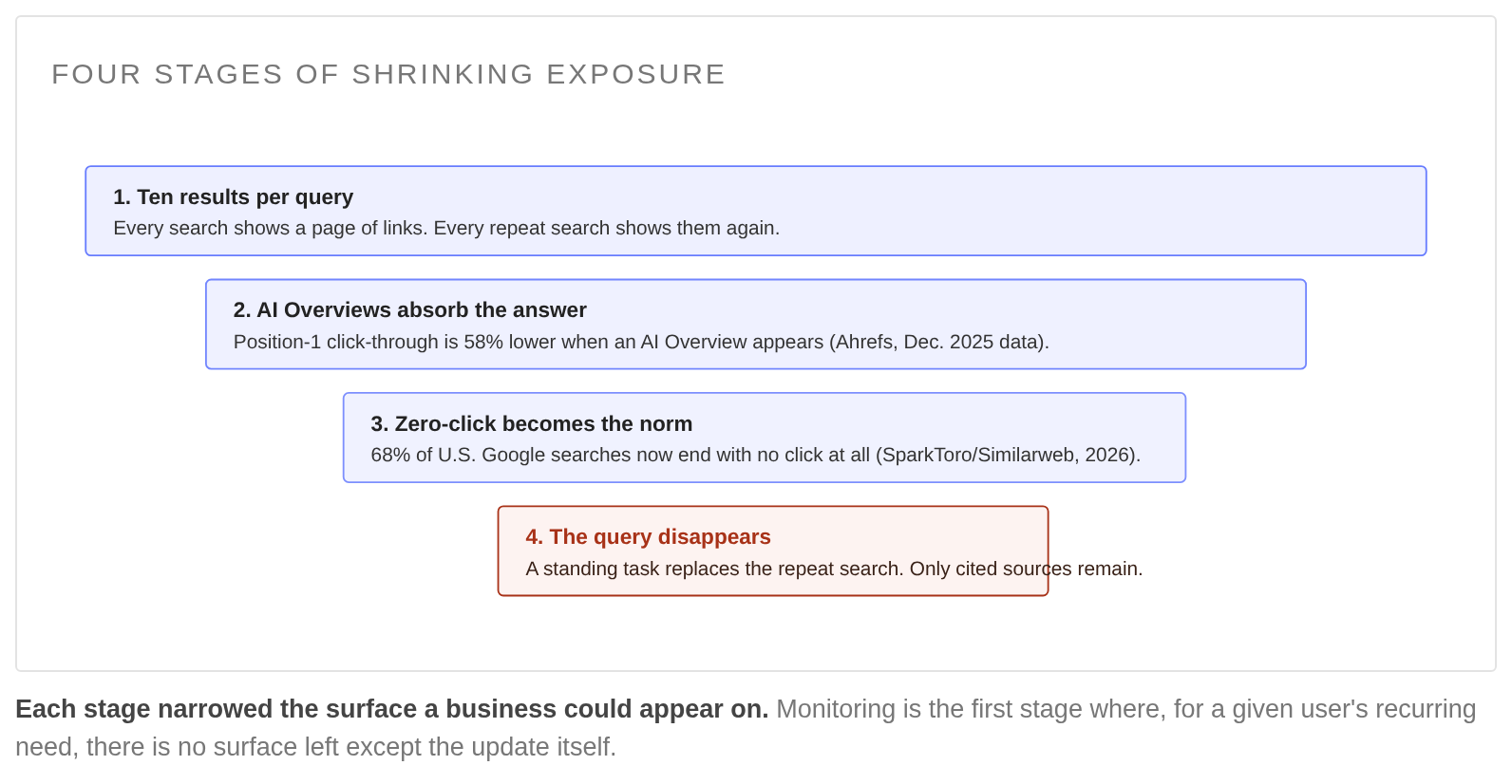
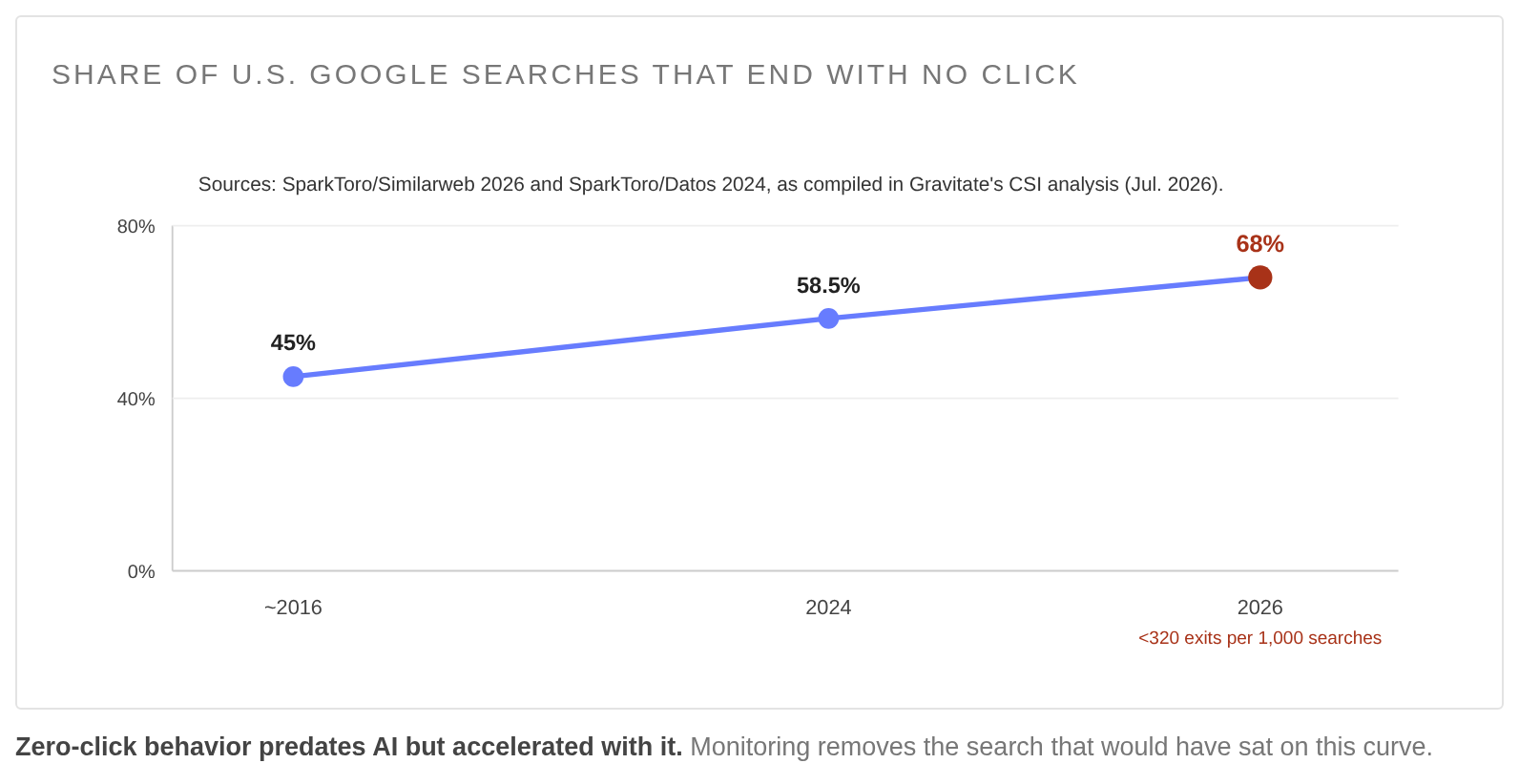
The numbers behind stages two and three are documented. Gravitate’s July analysis, compiling Ahrefs, SparkToro, Pew, and Chartbeat data, found that fewer than 320 of every 1,000 U.S. Google searches now lead to the external web, down from an estimated 45% zero-click rate a decade ago to 68% today (PR Newswire, July 9, 2026). A randomized field experiment by researchers at the University of Pennsylvania and Northeastern, published in August, supplied the causal evidence: users forced into AI Mode clicked out to websites less, ran fewer search sessions, and switched to Bing, DuckDuckGo, or Yahoo more often than the control group (draft paper, “AI in Search Reduces Publisher Referrals Without Improving User Experience: Experimental Evidence,” August 2026, as covered by Search Engine Journal).
The paper trail: what Google promised, and what it dropped
Three announcements in sixteen months describe this feature.
What the adjacent evidence suggests about source selection
Everything in this section is inference from published data on how AI answer engines cite sources. Google has not confirmed any of it as the mechanism behind monitoring updates.
Google has named the four pools a monitoring task reads from: the general web index, forums and social posts, real-time data feeds, and the Shopping Graph. The plausible question is which pool dominates which task type, and what gets a source chosen inside a pool.
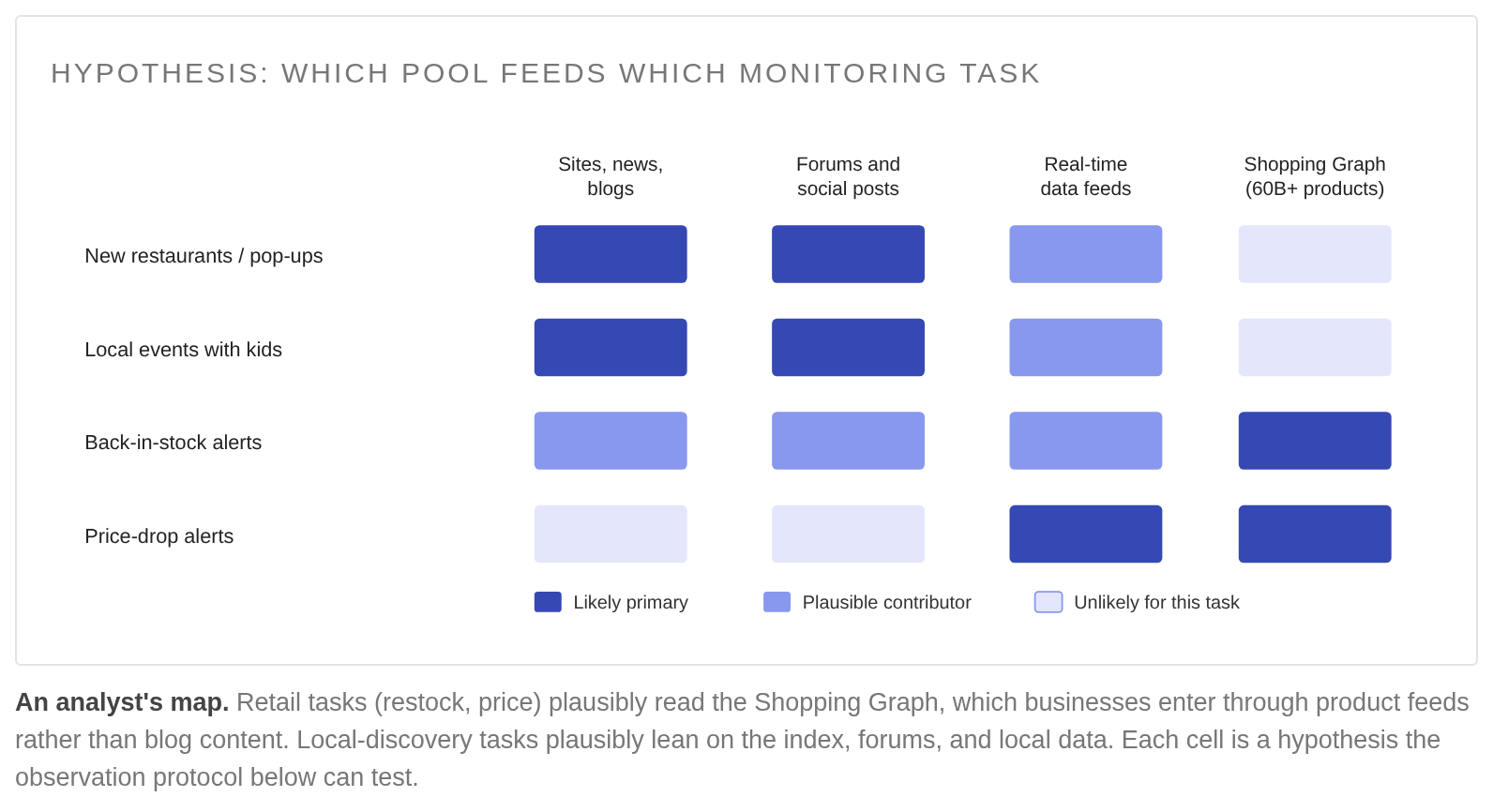
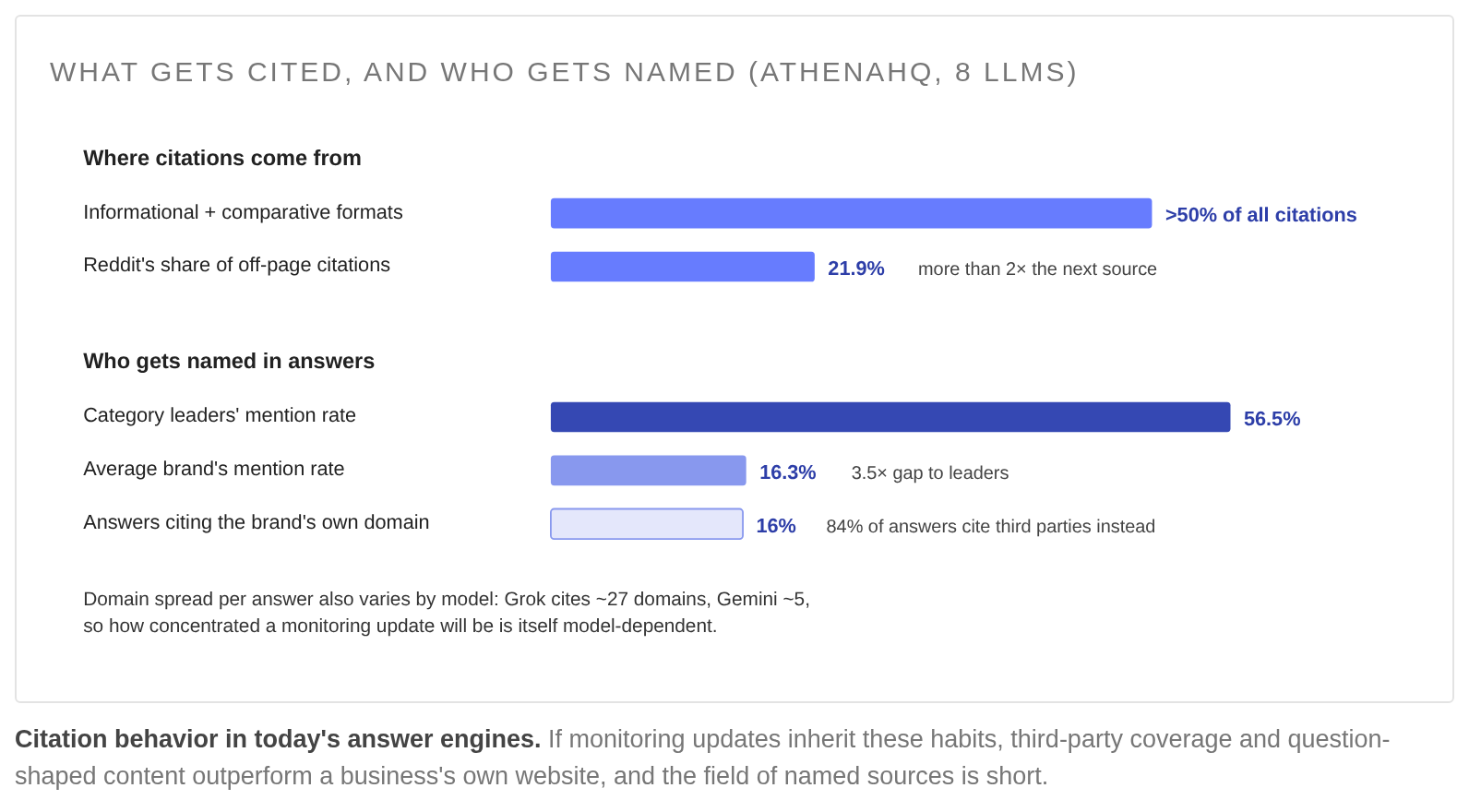
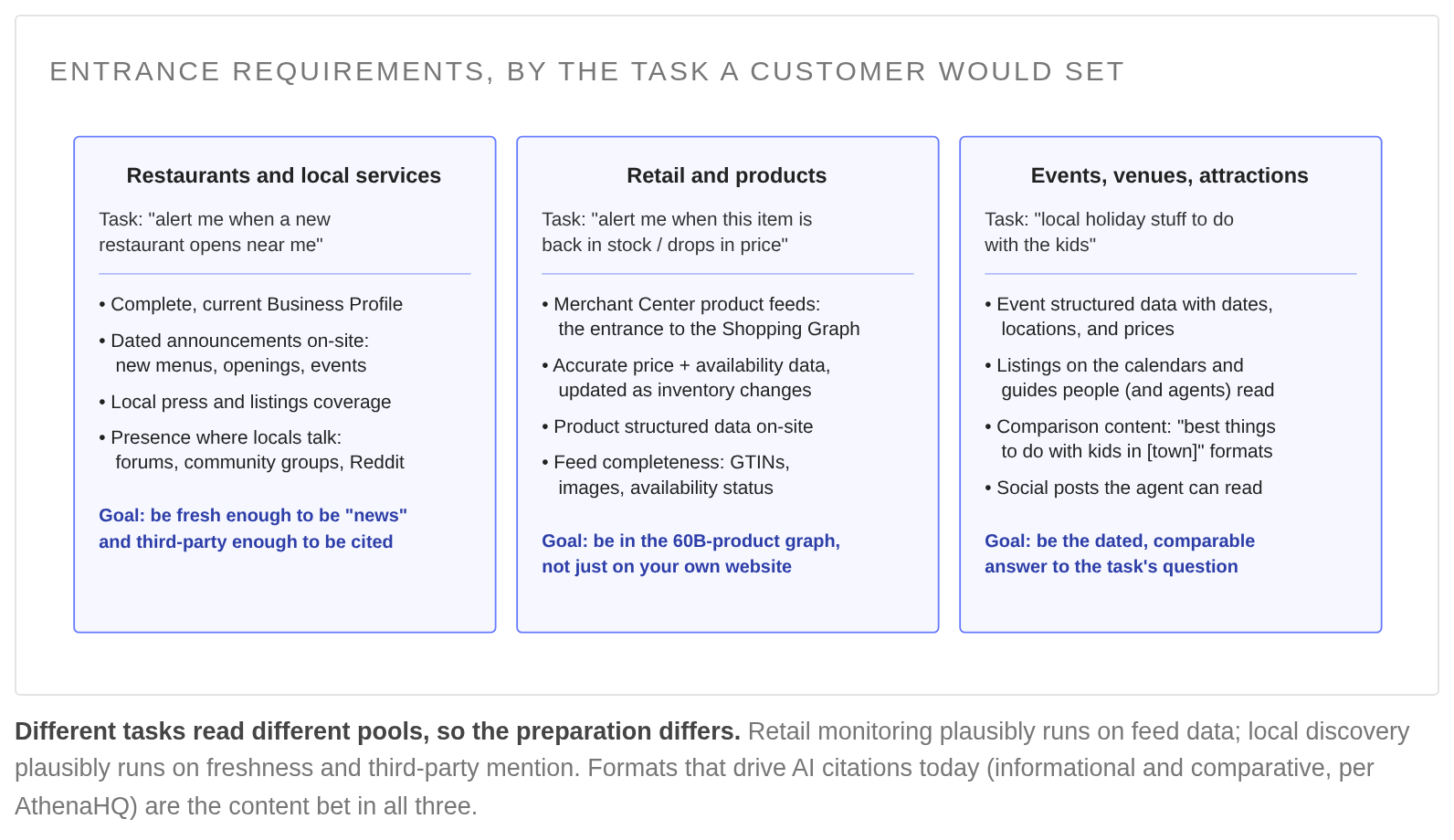
On what gets chosen inside a pool, the closest published evidence comes from AthenaHQ’s State of AI Search 2026 report, released the day after the rollout. Drawing on millions of AI-generated responses across eight large language models, it found that informational and comparative content formats drive more than half of all AI citations, that Reddit accounts for 21.9% of off-page citations (more than double the next closest source), and that a brand’s own domain goes uncited in 84% of AI answers (GlobeNewswire, Sept. 29, 2026). The average brand appears in 16.3% of AI answers; category leaders appear in 56.5%. AthenaHQ CEO Andrew Yan’s summary fits monitoring precisely: models show “the tendency to return to sources that have established trust.”
- Freshness determines whether an update happens. Monitoring exists to catch change. A static brochure page cannot produce the new information that makes an alert fire. Sources that update, event calendars, product feeds, dated announcements, menus, are the only ones positioned to be the reason an update exists.
- Third-party coverage plausibly outweighs what a business says about itself. If 84% of AI answers already cite external sources rather than the brand’s own domain, an agent answering “what’s new near me” will plausibly pull from local press, forums, listings, and reviews rather than from the businesses themselves.
- The candidate pool is being cleaned while it gets more valuable. Google’s September 2026 spam update, announced September 24 and still rolling out, is visibly hitting templated, programmatic, AI-generated pages; Lily Ray flagged “highly templated, programmatic, (probably) AI-generated pages” among early casualties. The same index the monitoring agent reads is losing exactly the thin content GEO spam produces.
How a local business becomes monitorable
The strategic question has shifted from “how do I rank for this query” to “am I inside the pool the agent reads, and am I the kind of source it returns to.” The entrance differs by task type:
The observation protocol: build your own ground truth
Google has published no dashboard, referral label, or Search Console surface for monitoring. Until that changes, the only ground truth is direct observation. The rollout is staggered, so not every account has the feature today; when yours does, this is the log worth keeping:
- Set up monitoring tasks for your own category in the Google app, phrased the way a customer would phrase them: “Alert me when a new [your category] opens in [your town].” Stein’s announced trigger phrases are “keep me updated on” and “alert me when.”
- Record the setup response. Google’s demo showed the agent listing what it will monitor; that list is the first visible glimpse of how broadly your task is scoped.
- For every update that arrives, log the date, the domains and sources it names, and whether it contains outbound links. The links question has a documented promise behind it (June) and a documented silence (September).
- Check whether your own business, or your known competitors, appear. Note which third-party sources the update leans on; those are the publications, forums, and listings worth earning coverage in.
- Watch Google Search Console and your analytics for anything new in referral patterns. If monitoring traffic is measurable, the first weeks are when the signature will be visible, before the noise of mass adoption covers it.
- Repeat weekly: two weeks of logs per task category is the minimum sample that separates a pattern from an anecdote.
The questions Google has not answered
As of this writing, there is no official answer to whether updates carry links, how sources are selected, how often the agent re-checks, how businesses can measure inclusion, or whether a business can ever know it has been skipped. Google’s pattern with AI Mode so far has been to announce capability and leave mechanics opaque; there is no reason to expect this rollout to differ.
Monitoring is unambiguously convenient for users: one instruction replaces a season of repeated searches. The same feature moves a recurring decision, which sources are worth a user’s attention, from an open results page to an agent whose selection criteria are unpublished. Stein ended his announcement with “Lots more to come!” The feature is two days into its global life. The businesses that set up their own tasks now and log what comes back will be the ones who can say, with evidence, how the agent chooses.
This article reflects the public record as of September 30, 2026. Primary sources: Robby Stein’s announcement as quoted by Search Engine Roundtable and Search Engine Journal; the Google I/O 2026 Search announcement; 9to5Google’s June launch coverage; the AthenaHQ State of AI Search 2026 report; Gravitate’s July 2026 analysis. Statements about likely source selection are labeled as inference and are not confirmed by Google.