ChatGPT’s source diet changed in September: YouTube citations down 91%, Wikipedia down 78%

Uncategorized

OpenAI announced nothing, but its tracking data shows the visible source list of ChatGPT answers collapsing domain by domain. The cause is OpenAI replacing borrowed search results with its own index, and it just invalidated the standard playbook for getting cited.

Between August and September, YouTube lost 91% of its share of ChatGPT’s visible citations. Facebook lost 88.1%, Wikipedia lost 78.4%, and Forbes lost 71.7%. OpenAI said nothing about any of it. The numbers surfaced on September 25 in a LinkedIn post by David Konitzny, a researcher at the GEO platform Peec AI, whose tracking runs hundreds of thousands of branded and non-branded prompts through ChatGPT on a fixed cadence. The next day the data reached r/SEO, where the top practical question, what replaced those sources, went unanswered.

The citation collapse tracks a structural change that Peec AI documented in primary-source research published the same month: ChatGPT has been swapping its retrieval pipeline from Google and Bing results, scraped through third parties, to a family of OpenAI-built indexes internally called Labrador. The domains losing citations are precisely the domains that only looked essential because of the old pipeline. Anyone whose 2026 GEO budget went to Reddit placements, Wikipedia positioning, or YouTube outreach for ChatGPT visibility just watched that thesis expire in a single month.

One month, four cliffs
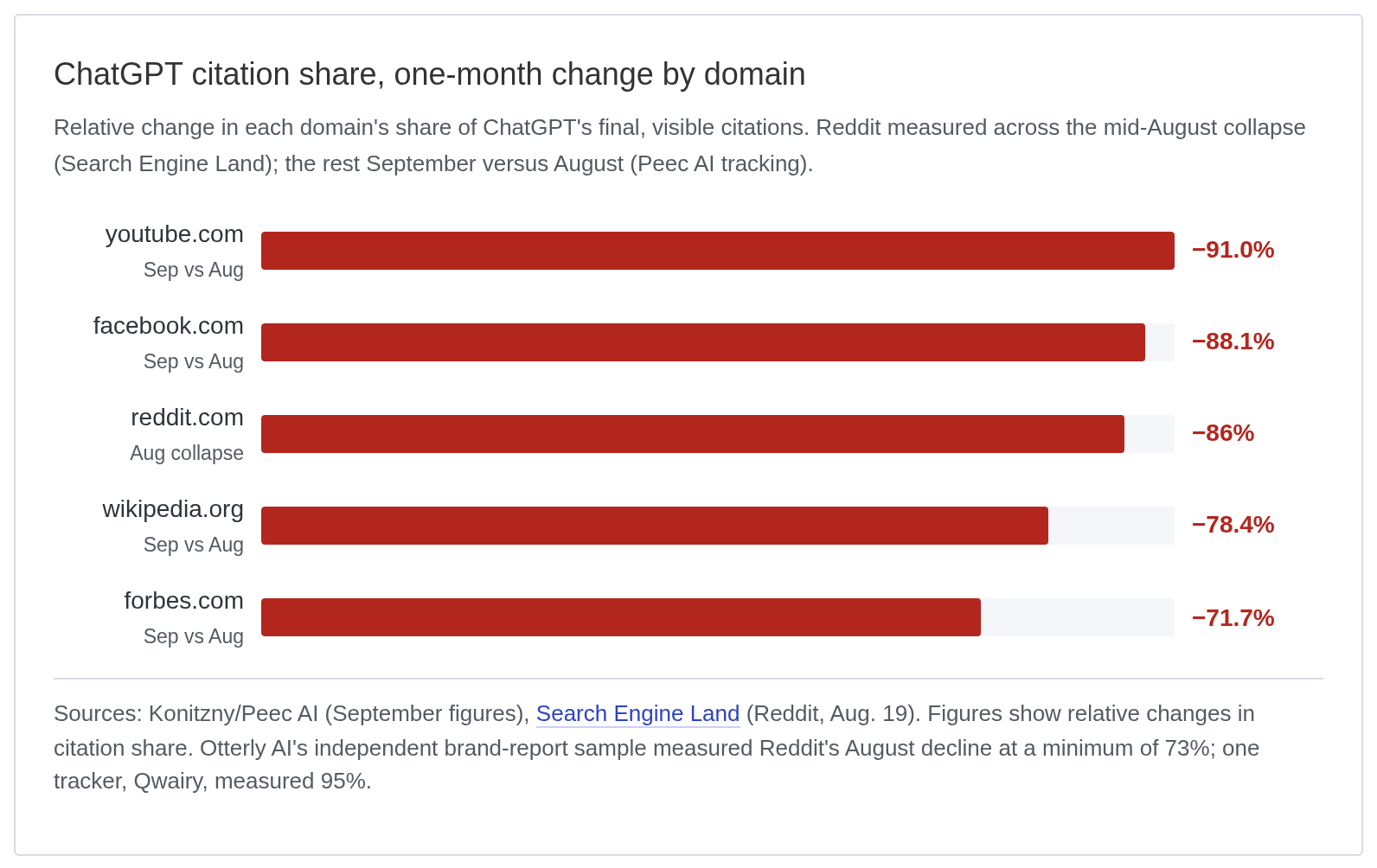
This measures citations: the links ChatGPT prints under an answer. Konitzny’s headline framing, “retrieved does not equal cited,” is the necessary correction; a domain can keep feeding ChatGPT’s answers while disappearing from the attribution. Citation share can also fall for benign methodological reasons, like the engine citing more sources overall. Konitzny checked for that by indexing YouTube’s absolute citation volume against a July baseline and found the drop there too. ChatGPT is citing YouTube less often.

What neither check can rule out is a change in disclosure behavior, with OpenAI retrieving the same sources and showing fewer of them. OpenAI has not commented, and no public statement explains any of these moves. The mechanism described below is the best-evidenced explanation so far.

The August cliff came first

September was not the first cliff, and knowing the August one changes how you read the data. On August 6, OpenAI made GPT-5.6 Luna the default model for ChatGPT’s free users. Within a week, ChatGPT began searching differently; within two, it had largely stopped citing Reddit. Reddit’s share of ChatGPT Search citations ran steady around 3.8% from mid-July, then fell to an average of 0.52% between August 14 and 17, according to Promptwatch tracking reported by Search Engine Land, with Forbes, Axios, and Search Engine Journal covering the drop.

Trackerly, another tracking vendor, watches both the citations ChatGPT prints and the pages it fetches while researching an answer. Through the collapse, roughly one in four pages ChatGPT retrieved was still a Reddit thread, the same ratio as July, per Trackerly’s analysis. OpenAI’s own documentation distinguishes the two lists, the sources consulted and the citations shown. Reddit stopped earning credit and referrals while continuing to shape answers. Ghost source is a fair term for what Reddit became, since its visible influence fell to zero while its actual influence stayed intact.

This is also the second time Reddit has been de-emphasized in a year. Between August and mid-September 2025, Reddit’s presence in ChatGPT answers fell from roughly 60% of tracked responses to around 10% in Semrush’s monitoring, a drop analysts including Kevin Indig tied to Google removing the num=100 parameter, which starved the third-party scraping pipes ChatGPT then relied on. That episode reversed, and by April 2026 Reddit was ChatGPT’s single most-cited domain at 4.14% of citations, per Forbes. The history shows that ChatGPT’s source mix is an operational setting that OpenAI adjusts, repeatedly, without announcement. The 2025 drop had an external cause, Google closing a door. The 2026 pattern has an internal one.

The swap: from borrowed search results to OpenAI’s own index

In early September, Peec AI published primary-source research showing that ChatGPT runs its own retrieval system, internally called Labrador, and that it is not one index but a family of twelve: general web, PDF, YouTube, news (with separate tiers for the last day, the last seven days, and older content), arXiv, Wikipedia, local, finance, legal, medical, shopping, and images. The full investigation is at Peec AI’s blog and docs.peec.ai.
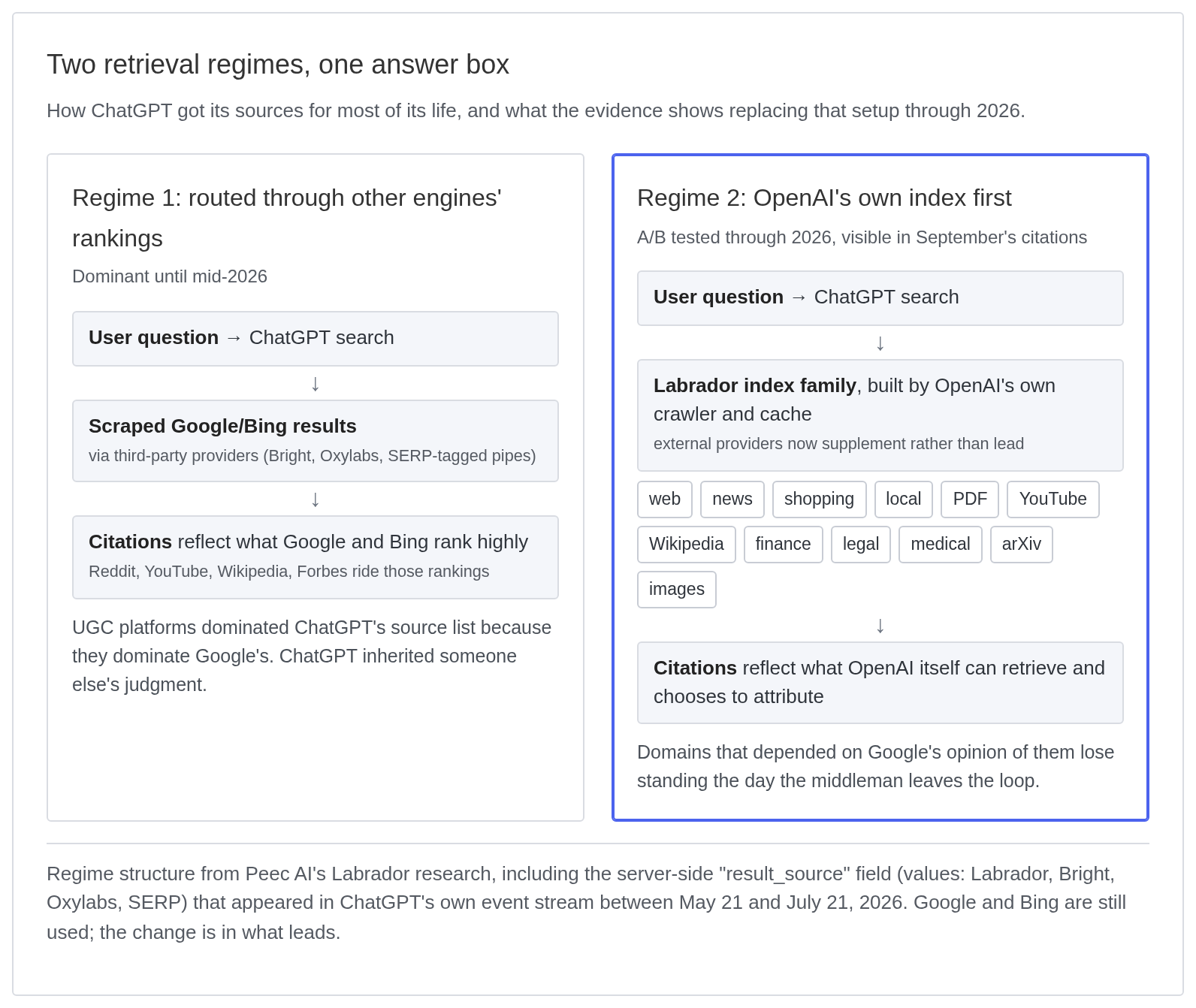
For two months, a field called result_source appeared in ChatGPT’s server-side events carrying only four values: Labrador, Bright, Oxylabs, and SERP. Three are external scraping providers; the first is OpenAI’s own index. OpenAI’s job postings ask for engineers to build “indexing systems, retrieval pipelines, and serving layers” at “exabyte scale,” a hiring push aimed at running the retrieval stack itself. In Google’s antitrust trial, Nick Turley, head of ChatGPT, testified that OpenAI began building its own search index in 2023 after Google refused to license its index, with an early target of answering 80% of queries from it, and that even with full access to Google’s data, five years would be needed just to determine whether full independence is achievable.

The build is already running. Peec AI observed an A/B test named “prefer-index-over-serp-v3” affecting 8% of chats in mid-August, and five separate shopping experiments running against the company’s own index as of September 2. To test crawl capacity, Peec researcher Metehan Yesilyurt published a one-billion-page website as a honeypot; by early September, ChatGPT’s crawler had taken 6 million pages and was still going at roughly 35,000 requests per hour. A cache is confirmed too. In ChatGPT’s lockdown mode, which cannot browse live pages, the system still served current versions of major SEO publications from stored copies. Meanwhile Google and Bing have not been switched off. Peec AI’s CPO Malte Landwehr verified live Google queries by watching a zero-traffic test site get a Google Search Console spike on the exact days he queried ChatGPT about it.

Why the losers lost

YouTube’s content is mostly video with thin crawlable text; a direct check of youtube.com’s robots.txt shows search results pages disallowed to all bots, and watch pages offer little to a crawler that does not render JavaScript. Google has first-party access to all of it; OpenAI’s crawler does not, and a commenter on Konitzny’s thread put the asymmetry plainly: Google indexes YouTube and Reddit directly, while Bing and Labrador have to crawl and carry far lower coverage of those platforms. Facebook pages are similarly walled off from crawlers. Forbes built a large share of its visibility on ranking in classic search results, exactly the layer being deprioritized.

Wikipedia is the exception that tests the explanation, because Labrador includes a dedicated Wikipedia vertical index. Coverage cannot account for that drop, which makes Wikipedia’s 78% decline evidence that something changed in which retrieved sources get printed as citations, whether a deliberate attribution policy or a disclosure change, and nobody outside OpenAI can say which yet.

What no honest analysis can claim is that these domains have been cut out of answers. Trackerly proved retrieval continued for Reddit; the same is plausible for the rest, and Konitzny explicitly frames his finding that way. The business consequence shifts rather than vanishes. A placement that used to bring a visible citation and a referral visit now brings invisible influence on the answer, which is harder to measure and easier for OpenAI to revoke.

What replaced them

The gain side of the ledger remains unpublished. Konitzny closes his post with “the interesting question is why,” and the practitioner threads asking “what will it cite now” have no data-backed answer yet. What the available evidence supports is directional: citations are consolidating on sources OpenAI can retrieve independently, which means pages its own crawler holds and can verify, without routing through a rival engine’s rankings. Commentary around the data describes the beneficiaries as official brand sites and institutional sources rather than social transcripts.

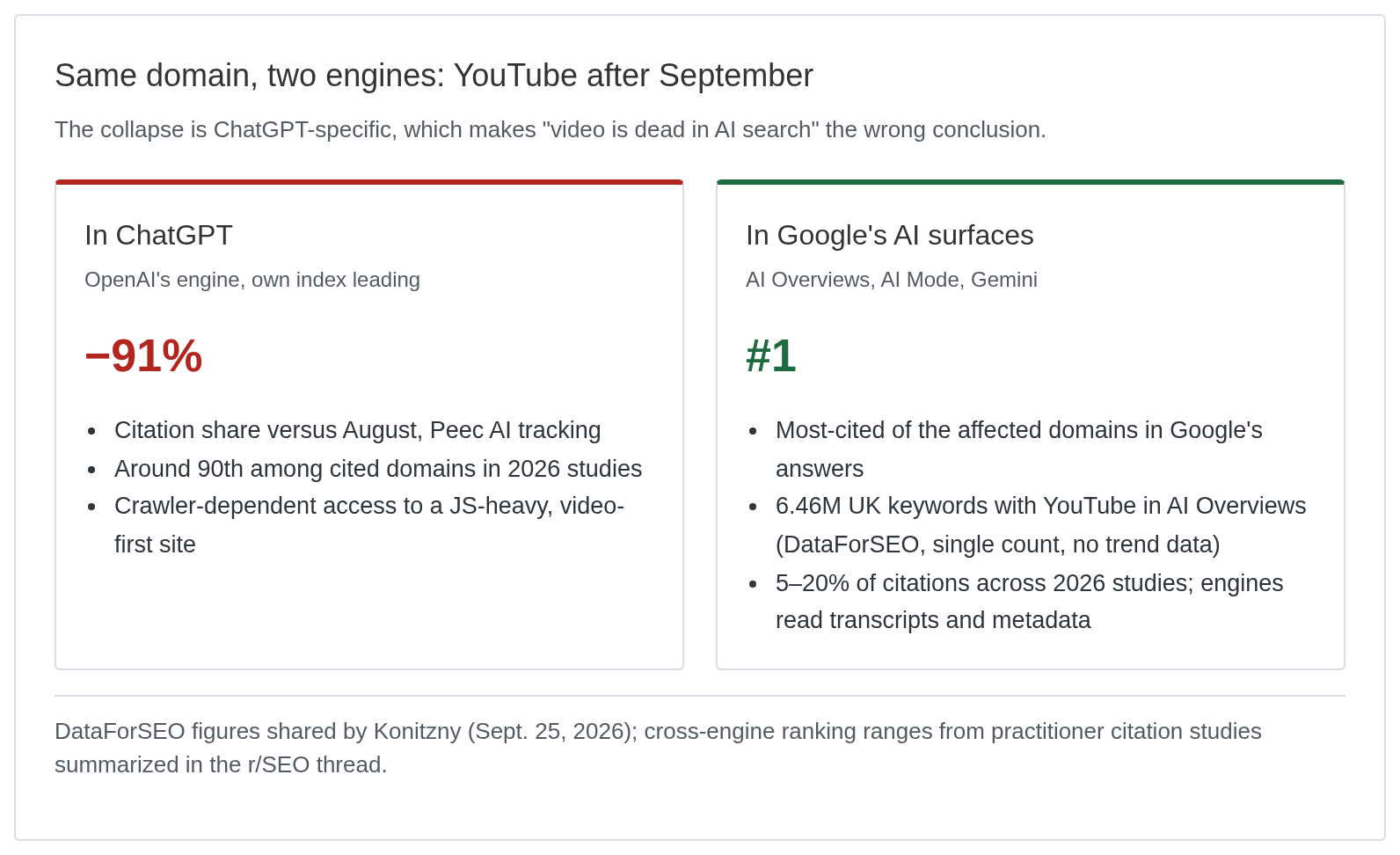
The collapse is specific to ChatGPT. On Google’s own surfaces, YouTube remains the strongest cited domain of this group. DataForSEO UK data shared in Konitzny’s thread shows YouTube appearing in AI Overviews across 6.46 million keywords, close to twice Wikipedia’s 3.49 million, though that is a count rather than a time series and cannot show a trend. Practitioner citation studies through 2026 consistently place YouTube as the most-cited domain in Gemini, AI Mode, and AI Overviews, at roughly 5% to 20% of citations depending on the study, while ranking around 90th in ChatGPT.
AthenaHQ’s State of AI Search report, released September 29 from millions of responses across eight LLMs, adds the frame: a brand’s own domain goes uncited in 84% of AI answers, and Reddit still supplies 21.9% of off-page citations when all engines are counted together. Grok cites an average of 27 distinct domains per response; Gemini cites five. Any strategy built on “AI search” as a single channel was already wrong before September.

The advice that just expired

The standard GEO playbook of 2025 and 2026 followed the data of its moment: 5W Research found Wikipedia and Reddit together driving over a quarter of US ChatGPT citations in early 2026, with Wikipedia at 13.15% and Reddit at 11.97%; Reddit peaked as ChatGPT’s single most-cited domain in April. Agencies sold placements on exactly those platforms, and through July, the placements worked. The advice failed because it described a pipeline OpenAI was actively replacing, and the data it rested on measured the middleman rather than the engine.
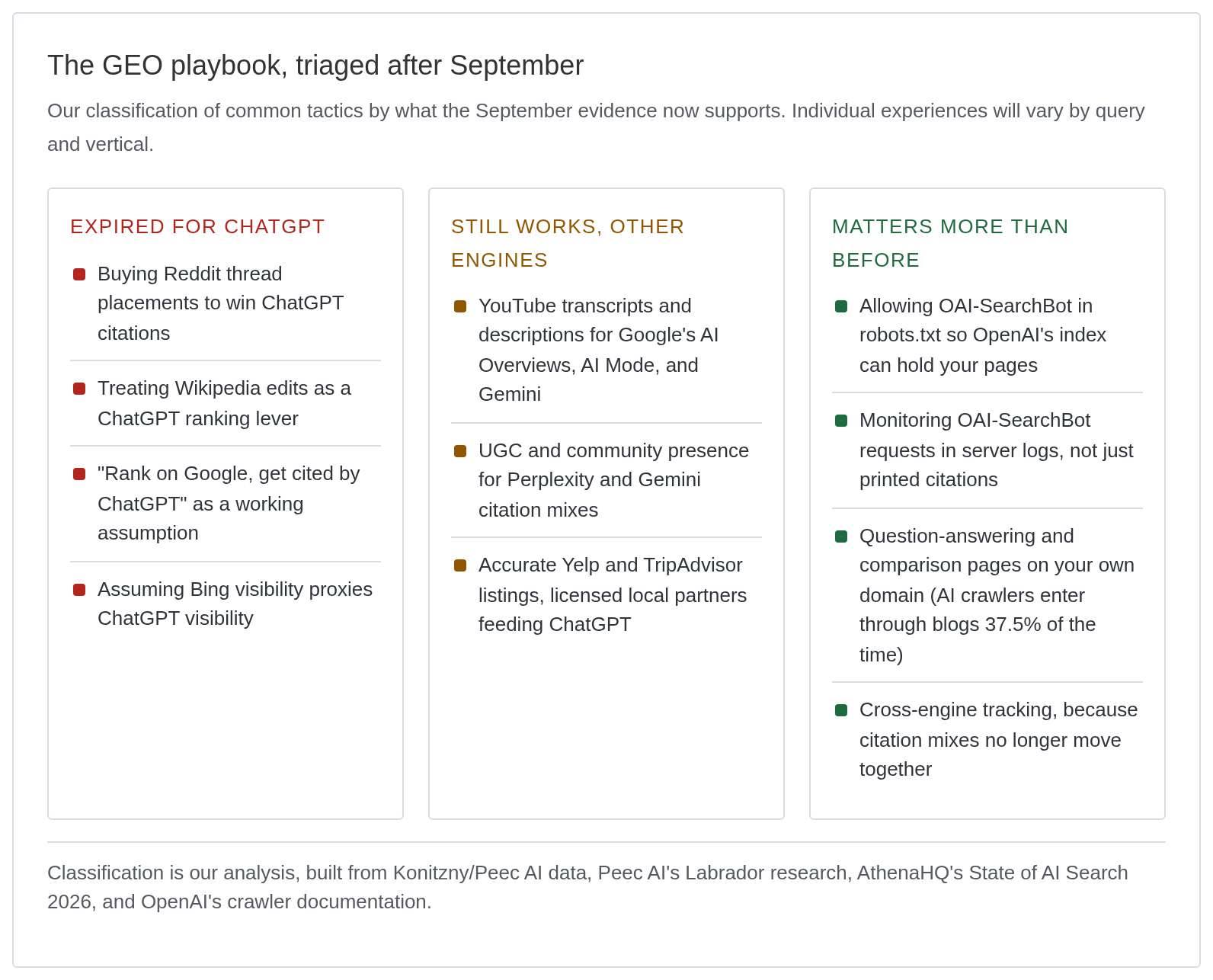
ChatGPT’s source mix has now shifted abruptly in September 2025, May 2026, August 2026, and September 2026, four times in thirteen months, each time without announcement. A tactic whose value depends on one engine’s current preference for a third-party platform has a shelf life measured in months. What survives regime changes is being crawlable by each engine’s own crawler and being the primary source for the facts about your own business.

The ten-minute audit

If you run a small business and this reads like insider noise, one audit covers it. OpenAI publishes exactly which crawler controls ChatGPT visibility, and it is not the one most sites have been managing.
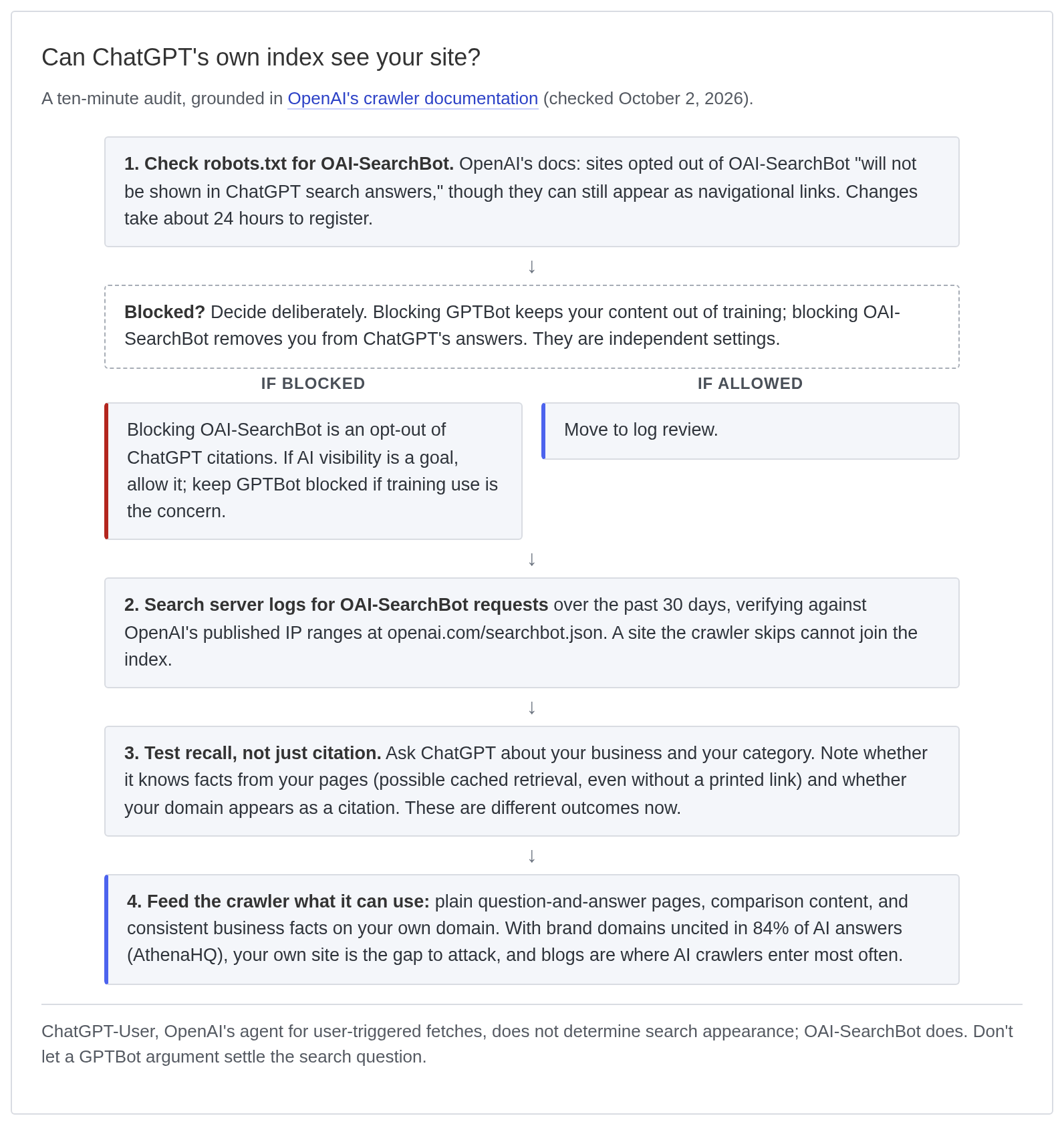
For practitioners, the measurement upgrade matters as much as the tactics. Citation trackers see only what OpenAI prints, and OpenAI has now shown twice in two months that printing and reading can decouple. The retrieval layer shows up in server logs for OAI-SearchBot, ChatGPT-User, and GPTBot, while citation tracking covers only the attribution layer. The strategy should watch both. And because engines no longer move together, a ChatGPT decline is not a signal to abandon YouTube work that serves Google’s surfaces, or Reddit work that serves Perplexity. The single-channel GEO retainer has been replaced by engine-by-engine management with retrieval monitoring underneath.

The direction of travel

Turley’s testimony supplies the horizon: full independence from outside search providers is “not something you switch on,” and OpenAI’s own estimate was five years to learn whether 100% is even achievable. So the September diet change is one monthly reshuffle in a multi-year migration, and the shopping experiments still running in production show OpenAI testing its index against borrowed results one vertical and one query type at a time.

For everyone whose visibility depends on these answers, that converts the lesson into a standing rule. The winners and losers of AI citations are now decided by whoever controls the index doing the retrieving, and that control is changing hands while the industry watches. Budget for monitoring, keep your own site crawlable and quotable, and treat any playbook older than one quarter as unproven until current data supports it.

Sources

Figures attributed to vendors (Peec AI, Promptwatch, Otterly, Qwairy, DataForSEO, AthenaHQ) come from those companies’ own tracking products; each has a commercial interest in GEO measurement. OpenAI has issued no public statement on any of these changes as of October 2, 2026.
How Is AI Being Used in Western Massachusetts? Applications in Key Industries

Uncategorized

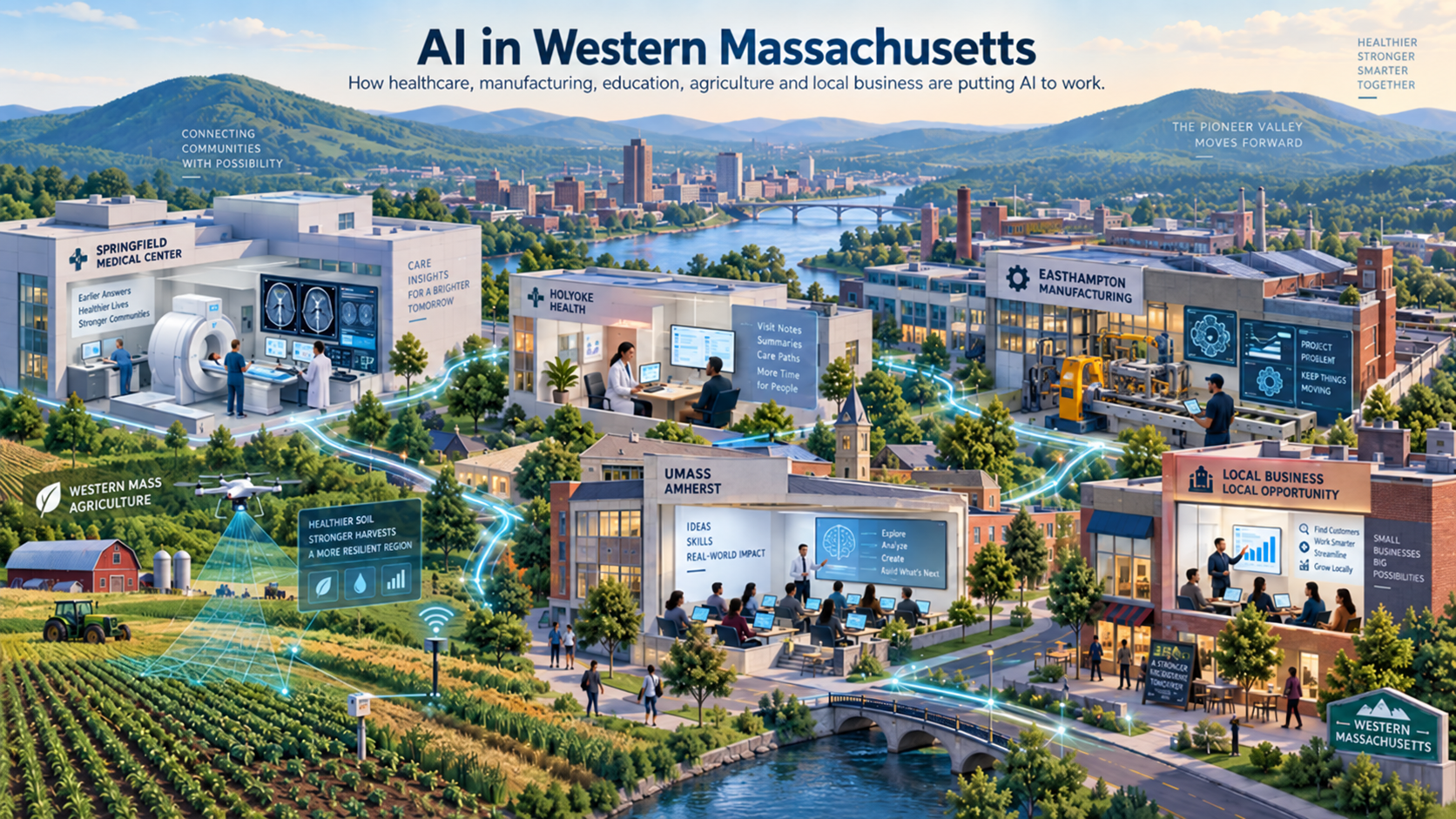
Artificial intelligence is no longer just something you hear about in big cities or tech hubs, it’s right here in Western Massachusetts, quietly changing how we live and work. From hospitals to farms, schools to factories, AI tools are helping people do things smarter and faster. You might not notice it at first, but behind the scenes, local businesses and institutions are using AI to solve tricky problems and make everyday tasks easier. This article takes a closer look at some of the ways AI is making a real difference in our region’s key industries, and how it could affect you too.

In Western Massachusetts, AI is being utilized across various industries including healthcare, education, manufacturing, and digital marketing to enhance efficiency and innovation. Local companies like Oak Web Works leverage AI-driven services such as Generative Engine Optimization (GEO) to improve business visibility on emerging AI search platforms, helping regional businesses compete effectively in both traditional and AI-powered digital landscapes.

AI Advancing Healthcare Systems

At Baystate Health’s Springfield imaging center, AI-enhanced MRI technology is being used to improve image quality and shorten scan times. The technology can help radiologists obtain high-quality diagnostic images more efficiently while reducing the amount of time patients spend in the scanner.

Holyoke Medical Center has adopted AI-powered tools such as Suki AI to assist clinicians with documentation and administrative tasks, giving providers more time to focus on direct patient care.

Holyoke Medical Center’s use of Suki AI reflects another important application of artificial intelligence in healthcare: reducing administrative work. By helping providers draft clinical notes and patient instructions, the technology can reduce time spent on documentation and allow clinicians to devote more attention to patients. Of course, none of this would reach patients efficiently without smoother operations behind the scenes.

Administrative burdens have long been a source of frustration in healthcare—paperwork piles up, appointments get delayed, and staff burnout rates climb. Healthcare organizations are increasingly exploring AI and automation for repetitive administrative tasks such as scheduling, documentation and billing workflows. When implemented appropriately, these tools can reduce manual work and help staff devote more time to patient-facing responsibilities.

By streamlining workflow processes through AI adoption, Western Massachusetts healthcare providers are enhancing efficiency while preserving the human touch that remains essential in medicine.

AI-assisted imaging can help healthcare providers improve the efficiency and quality of diagnostic workflows. In applications such as MRI, AI can enhance image reconstruction and reduce scan times, potentially improving the patient experience while supporting clinicians with clearer diagnostic images.

For practices navigating these technological changes, partnering with experts who understand both healthcare nuances and advanced digital tools is crucial. Companies like Oak Web Works in Springfield specialize in SEO and Generative Engine Optimization (GEO) designed to elevate visibility for healthcare services using AI-driven platforms. Their tailored digital marketing strategies help connect providers with more patients seeking innovative care options powered by AI technologies.

If you’re part of Western Massachusetts healthcare—whether hospital leadership or clinic manager—embracing AI now offers a chance not only to improve patient outcomes but also to reduce operational costs and build stronger community trust in your services through smarter marketing outreach.

While healthcare showcases clear benefits from artificial intelligence, its influence extends into many other vital sectors across the region—each harnessing AI’s potential in distinctive ways.

Precision Agriculture with AI

Farming in Western Massachusetts is evolving rapidly as AI technologies blend with traditional practices to create smarter, more efficient operations. At its core, precision agriculture harnesses the power of data and automation to closely monitor crops and soil conditions, allowing farmers to make informed decisions that improve yield while conserving resources. This approach goes far beyond simply planting seeds and hoping for the best; it’s about knowing exactly what your land needs and when.

Imagine a farm where drones equipped with AI-powered cameras fly overhead, scanning crops for early signs of disease or pest infestations before they become visible to the naked eye. These flying scouts gather thousands of images daily, which AI algorithms analyze to detect subtle color changes or growth patterns that indicate stress. Early detection means timely interventions such as targeted pesticide application or nutrient adjustments, reducing waste and promoting healthier crops.

To implement this kind of monitoring effectively, farmers invest in drones or collaborate with service providers who can fly scheduled missions over their fields. The key insight is that collecting data isn’t enough — it must be processed intelligently. Predictive analytics come into play here, offering forecasts of crop yields based on historical trends combined with current environmental conditions such as rainfall, temperature, and soil quality.

AI TechnologyApplicationBenefits
Drones with AICrop health assessmentEarly disease detection
Predictive AnalyticsYield predictionOptimized planting schedules
Automated SensorsSoil quality monitoringBetter resource management

Beyond aerial surveys, automated ground sensors embedded in fields provide real-time data about soil moisture levels, nutrient content, and pH balance. Farmers use this information to optimize irrigation schedules and fertilizer use, ensuring plants receive exactly what they need—no more and no less. This careful balance reduces environmental impact and lowers input costs without sacrificing productivity.

Such precise management has tangible benefits not only for the environment but also for the bottom line. Less resource consumption means savings on water, fertilizers, and pesticides. Moreover, healthier plants are more resilient against diseases and weather fluctuations.

In Western Massachusetts specifically, farms in towns like Granby, Southwick, and Hadley have begun to utilize AI. By integrating AI-powered drones into their routine crop monitoring, their goal is significant yield increases. These gains are significant when margins in farming tend to be tight and unpredictable market forces dominate.

It’s essential to note that adopting AI doesn’t mean replacing traditional knowledge but amplifying it. Experienced farmers still make critical judgments but now armed with richer data and predictive insights for sharper decision-making.

For growers interested in dipping their toes into precision agriculture, starting small can be effective: perhaps first experimenting with drone imagery on a small section of land or installing a few soil sensors before scaling up. Partnering with specialists knowledgeable in AI technology applications for agriculture can ease this transition by providing strategic guidance and technical support adapted to regional needs.

Economic Impact of AI in Western Mass.

The economic landscape of Western Massachusetts is shifting under the influence of artificial intelligence, creating opportunities and challenges alike. AI’s role isn’t limited to productivity alone; it’s reshaping how businesses operate, how employees work, and how value is generated throughout the region. For those living here or running companies, understanding this transformation is vital.

One key area is job creation and transformation. New AI-related roles have emerged just in the past year. This isn’t only about entirely new positions like data scientists or machine learning engineers but also about existing jobs evolving dramatically. For example, manufacturing technicians now often monitor AI systems that predict equipment failures before they happen. This shift demands a workforce prepared to engage with technology rather than replace it—blending human insight with AI-driven decision-making.

If you’re part of today’s workforce or planning a career path, acquiring skills related to AI technologies will pay dividends. Learning basics of data analysis, programming languages relevant to AI applications, or simply becoming comfortable interpreting insights from AI tools can position you for the jobs growing locally.

On the business side, profitability gains are already tangible. AI allows businesses to keep facilities running smoothly and allocate resources more strategically. Moreover, efficiency improvements don’t stop there: inventory management, customer service automation, and marketing personalization further amplify profitability.

This kind of operational enhancement can be particularly transformative for small to medium enterprises (SMEs) across Western Massachusetts. It levels the playing field, enabling smaller businesses to compete with larger corporations by using AI tools designed initially for enterprise-level firms. However, the challenge lies in access and awareness – many companies hesitate due to perceived complexity or upfront cost.

Partnering with local digital marketing firms like Oak Web Works can help businesses navigate these hurdles by integrating AI into their SEO and GEO strategies. Oak Web Works specializes not just in traditional SEO but also Generative Engine Optimization (GEO), optimizing brands for emerging AI-driven platforms like ChatGPT and Google AI Overviews. Our expertise can help your business gain visibility where it matters most in today’s AI-enhanced search ecosystem.

Economic vitality also benefits from the ripple effect, growth spurs innovation hubs and talent pools that attract investments beyond established sectors. Regional universities and tech startups increasingly collaborate on AI research projects that promise future breakthroughs while simultaneously nurturing local job growth.

AI in Educational Institutions

AI has moved far beyond science fiction to become an integral part of modern classrooms and campus administration. In Western Massachusetts, schools and colleges are embracing AI technologies to tailor education in ways that were unthinkable just a few years ago. Local institutions including UMass Amherst and Amherst College are actively exploring AI in teaching and learning. At UMass, educators and researchers are studying applications ranging from personalized tutoring and feedback to AI-assisted coursework, while Amherst College has expanded access to generative AI tools and is examining how they should be used responsibly in a liberal-arts environment.

Such personalization helps bridge gaps between students with varied learning speeds and styles, ensuring nobody falls behind simply because traditional methods don’t match their needs. These AI tools constantly reassess progress and adjust challenges accordingly, fostering a customized learning environment that can motivate students more deeply than one-size-fits-all lectures ever could.

Meanwhile, the impact of AI extends well beyond the classroom experience. Educational administrators are turning to AI-driven platforms to streamline many time-consuming operational tasks. Admissions offices utilize intelligent systems to sift through applications quickly and fairly, while predictive analytics help identify students who might need extra support early on.

Moreover, automating routine paperwork means educators spend less time on bureaucracy and more time focusing on teaching and mentoring.

This optimization fundamentally changes the rhythm of academic life. Rather than drowning in forms and data entry, teachers can devote their energy where it matters most, engaging with students and enhancing curriculum development. Additionally, school leadership gains clearer insight from AI dashboards that monitor institutional performance metrics in real time, improving decision-making workflows.

For institutions considering adopting AI solutions, it’s wise to start with clearly defined goals—whether personalizing instruction or reducing administrative overhead—and then select platforms tailored to those objectives. Partnering with experienced digital marketing agencies like Oak Web Works, which specializes in emerging technologies including AI visibility and optimization within Western Massachusetts, can help schools navigate this evolving landscape successfully.

As these educational innovations take root locally, industries across the region are similarly leveraging AI’s transformative potential to reshape how they operate and compete.

AI Innovations in Local Businesses

At its core, AI’s role in local businesses often centers around improving efficiency and tailoring customer experiences. Retailers, for example, are no longer relying solely on intuition or traditional marketing tactics. Instead, they use sophisticated algorithms to dissect purchasing data, spotting trends and predicting demand with an accuracy that was science fiction a decade ago. This means shelves stay stocked with what customers want before they even realize it themselves. Inventory management becomes a dynamic process rather than a reactive one, minimizing waste and optimizing profit margins.

Customer experience benefits substantially from these advances. Personalized marketing campaigns generated by AI analyze not just purchase history but also browsing behavior and social media trends to deliver offers that feel individually crafted. It’s the digital equivalent of a knowledgeable shopkeeper remembering your preferences, only scaled up to hundreds or thousands of customers simultaneously.

Manufacturing stands as another pillar where AI is quietly reshaping how work gets done, often without drawing much attention outside industrial circles.

Easthampton-based MachineMetrics provides AI-powered predictive-maintenance technology that uses real-time machine-condition data to help manufacturers identify potential equipment problems before failures occur. These insights can help maintenance teams intervene earlier and reduce unplanned downtime.

The result is a smarter factory floor where machines effectively “talk” to workers through software alerts. With less unplanned downtime, manufacturers boost output while preserving machine longevity. This integration highlights a shift from routine preventative maintenance schedules toward adaptive strategies based on actual operational data—a significant leap forward in industrial efficiency.

These AI-powered efficiencies aren’t limited to retail or manufacturing; local businesses across sectors are beginning to explore similar tools tailored to their unique needs.

Services ranging from healthcare providers streamlining patient intake processes through AI-enabled chatbots, to restaurants using data analytics for supply chain optimization, show how versatile AI has become at enhancing operational workflows. Even small businesses benefit by automating repetitive tasks like scheduling or customer follow-ups, freeing up human effort for higher-value activities like personalized client care and strategic growth initiatives.

For local businesses eager to harness AI’s potential but unsure where to start, collaborating with specialists skilled in digital marketing and Generative Engine Optimization (GEO) can be essential. Firms like Oak Web Works in Springfield bring nearly two decades of experience helping regional enterprises not only adopt SEO but also optimize presence across emerging AI-driven search platforms such as ChatGPT and Google’s AI Overviews. Their expertise bridges the gap between traditional web marketing and next-generation AI visibility solutions—critical for staying competitive in today’s evolving digital economy.

“AI isn’t just a futuristic concept anymore; it’s becoming woven into the fabric of everyday business,” says Jason O’Connor of Oak Web Works. “Our goal is to help Western Massachusetts companies become more visible in the LLMs and discover ways of leveraging AI to help streamline their businesses.”

As these innovations continue gaining momentum locally, understanding the tangible benefits, from inventory foresight to predictive maintenance, offers actionable insights for businesses aiming to grow smarter alongside technology rather than chasing after it blindly.

Future AI Trends in Western Massachusetts

The landscape of AI is continuously evolving, and Western Massachusetts stands at the cusp of significant advances that will shape everything from community life to industrial productivity. One of the most promising developments lies in AI-enhanced public services. Imagine your local municipality using intelligent systems not only to optimize bus routes but also to anticipate safety concerns with predictive policing models. This isn’t just about convenience, it’s about making community services smarter, faster, and more responsive to citizens’ needs.

Such improvements have the potential to transform everyday experiences. For instance, reducing wait times for buses or ensuring resources are allocated efficiently during emergencies can greatly elevate quality of life. These shifts depend on integrating AI tools that digest vast amounts of data—from transit schedules to crime statistics, and turn them into actionable insights. As cities adopt these solutions, residents can expect tangible benefits like less congestion and improved security.

Shifting gears from public services, the industrial sector is equally poised for an infusion of smart technology through collaborative robotics, commonly referred to as “cobots.”

Cobots represent a hybrid approach where machines and humans team up rather than compete. Rather than replacing workers, these robots undertake repetitive, precise tasks such as assembly line work or quality inspections, freeing employees to focus on complex problem-solving and creative input. In manufacturing-heavy regions of Western Mass, integrating cobots can boost productivity without sacrificing jobs, an important balance for sustainable growth.

The ripple effects extend beyond efficiency gains. Employees often find such partnerships less physically taxing and more engaging since monotony decreases. Moreover, cobots improve safety by handling hazardous duties while working safely alongside humans. As industries embrace these technologies, this synergy shapes a future workplace that is both human-centered and technologically empowered.

Alongside these practical applications, AI’s role in advancing sustainability targets some of the most urgent challenges facing communities today.

Sustainability in this context means harnessing AI’s analytical power to optimize how energy is consumed and waste is managed, two factors directly tied to environmental impact. Whether it’s a manufacturing facility using AI-driven sensors to reduce electricity use during off-peak hours or a commercial building optimizing heating and cooling systems automatically based on occupancy patterns, these smart adjustments accumulate into significant resource savings.

Waste management can also benefit from AI through better sorting systems that identify recyclable materials more accurately or predictive analytics that streamline trash collection routes. The result is a localized response to climate change, one where Western Massachusetts businesses and homeowners become active participants in reducing their carbon footprint through technology.

For business owners pondering how to navigate this evolving AI landscape, partnering with experts who understand both traditional SEO and cutting-edge Generative Engine Optimization (GEO) is vital. Oak Web Works specializes in making your brand visible across conventional search engines like Google and emerging AI platforms such as ChatGPT and Claude—all while tailoring strategies for Western Massachusetts markets and beyond.

Whether you’re a manufacturer interested in promoting your use of collaborative robotics or a city agency looking to enhance public service communication through AI-driven insights, we’re here to help you position your brand front and center in the digital age.

Get ahead today by visiting Oak Web Works or calling 617-320-3134 for a personalized consultation on integrating AI visibility into your marketing strategy.

Western Massachusetts is embracing AI not just as a tool but as a transformative force reshaping industries, communities, and sustainability efforts alike. Staying informed and connected with expert partners ensures you can harness these opportunities to their fullest potential.